Newgreen Supply Food/Industry Grade Enzyme Notatin Liquid

Product Describtion:
Notatin is a glucose oxidase (GOD) produced by Penicillium notatum, with an enzyme activity of ≥10,000 u/g. Notatin can efficiently catalyze the reaction of β-D-glucose with oxygen to produce gluconic acid and hydrogen peroxide (H₂O₂).
Notatin with an enzyme activity of ≥10,000 u/g is an efficient and multifunctional glucose oxidase widely used in food, medicine, feed, biotechnology, textiles, environmental protection and cosmetics. Its high activity, specificity and environmental friendliness make it a key enzyme for glucose oxidation and oxygen removal, with important economic and ecological benefits. The powder form is easy to store and transport, suitable for large-scale industrial applications.
COA:
| Items | Specifications | Results |
| Appearance | white powder | Complies |
| Odor | Characteristic smell of fermentation odor | Complies |
| Activity of enzyme
(Notatin) |
≥10,000 u/g | Complies |
| PH | 5.0-6.5 | 6.0 |
| Loss on drying | <5 ppm | Complies |
| Pb | <3 ppm | Complies |
| Total Plate Count | <50000 CFU/g | 13000CFU/g |
| E.Coli | Negative | Complies |
| Salmonella | Negative | Complies |
| Insolubility | ≤ 0.1% | Qualified |
| Storage | Stored in air tight poly bags,in cool and dry place | |
| Shelf life | 2 years when properly stored | |
Function:
Highly Efficient Catalytic Glucose Oxidation:
Catalytic reaction: β-D-glucose + O₂ → gluconic acid + H₂O₂
Strong specificity, mainly acts on β-D-glucose, and has almost no effect on other sugars.
Antioxidant Effect:
Delays the oxidation and deterioration of food and medicine by consuming oxygen.
Antibacterial Effect:
The generated hydrogen peroxide (H₂O₂) has a broad-spectrum antibacterial property and can inhibit the growth of bacteria and mold.
Ph Adaptability:
The best activity is shown under weakly acidic to neutral conditions (pH 4.5-7.0).
Temperature Resistance:
Maintains high activity within a moderate temperature range (usually 30-50°C).
Environmental Protection:
As a biocatalyst, it can reduce the use of chemical reagents and reduce environmental pollution.
Application:
Food Industry:
1.Food preservation: used to remove oxygen from food and extend shelf life, such as beverages, dairy products, canned foods, etc.
2.Baking industry: used to improve dough texture, enhance gluten strength, and increase bread volume and taste.
3.Egg processing: used to remove glucose from egg liquid, prevent browning (Maillard reaction), and improve egg powder quality.
4.Wine and beer production: used to remove residual glucose and stabilize product quality.
Pharmaceutical Industry:
1.Blood sugar detection: as a key component of biosensors, used in blood sugar test strips and blood sugar meters to quickly detect blood sugar levels.
2.Wound care: using the hydrogen peroxide it generates for antibacterial dressings to promote wound healing.
3.Antibacterial drugs: as a natural antibacterial agent, used to develop new antibacterial drugs.
Feed Industry:
1.As a feed additive, used to improve feed preservation and prevent oxidative deterioration.
2.Inhibit the growth of mold and bacteria in feed by consuming oxygen.
Biotechnology Research:
1.Used for glucose detection and analysis, such as biosensors and laboratory reagents.
2.In enzyme engineering and protein research, it is used as a model enzyme for catalytic mechanism research.
Textile Industry:
1.Used in textile bleaching process, using the generated hydrogen peroxide as a bleaching agent to replace traditional chemical bleaching methods.
Environmental Protection Field:
1.Used in wastewater treatment to degrade organic pollutants containing glucose.
2.In biofuel cells, it is used as a biocatalyst for glucose oxidation reactions.
Cosmetics Industry:
1.As an antioxidant, it is used in skin care products to delay product oxidation and deterioration.
2.Its antibacterial effect is used to develop antibacterial cosmetics.
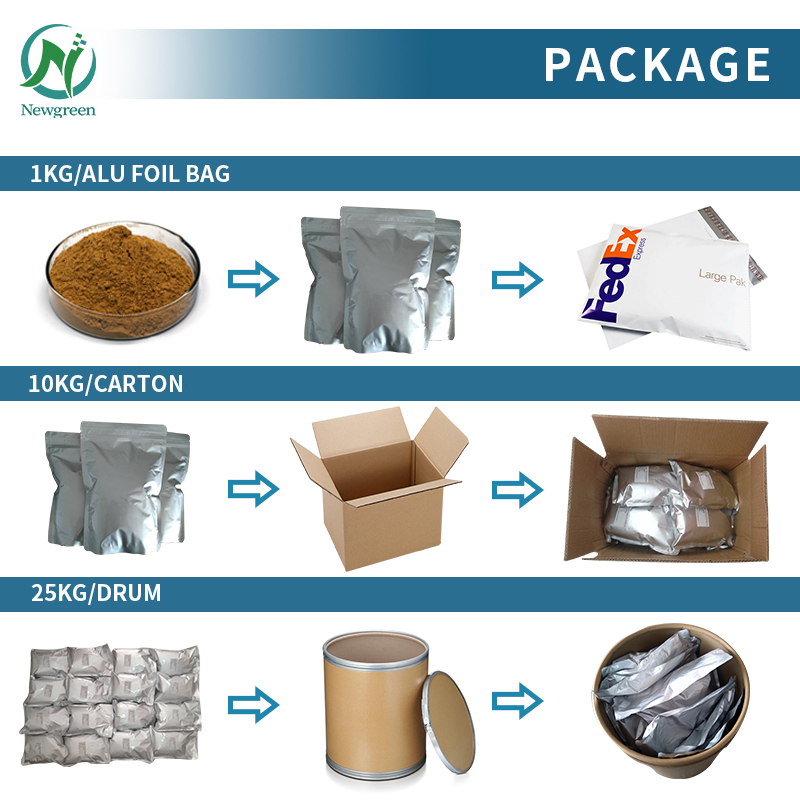
Package & Delivery