Newgreen Supply Liquid Cellulase Enzyme With Best Price

Product Description
Liquid cellulase with CMC (carboxymethyl cellulose) enzyme activity ≥ 11,000 u/ml is a highly active cellulase preparation specially used to catalyze the hydrolysis of cellulose derivatives such as carboxymethyl cellulose (CMC). It is produced by microbial fermentation technology, extracted and purified into liquid form, with high concentration and high stability, suitable for industrial applications.
Liquid cellulase with CMC activity ≥ 11,000 u/ml is a highly efficient cellulase preparation, widely used in textiles, papermaking, food, feed, biofuels, detergents and biotechnology. Its high activity and broad spectrum make it a key enzyme in cellulose degradation and biomass conversion, with important economic and environmental value.
COA
| Items | Specifications | Results |
| Appearance | Free flowing of the light yellow solid powder | Complies |
| Odor | Characteristic smell of fermentation odor | Complies |
| Activity of enzyme
(Cellobiase) |
≥11,000 u/ml | Complies |
| PH | 4.5-6.5 | 6.0 |
| Loss on drying | <5 ppm | Complies |
| Pb | <3 ppm | Complies |
| Total Plate Count | <50000 CFU/g | 13000CFU/g |
| E.Coli | Negative | Complies |
| Salmonella | Negative | Complies |
| Insolubility | ≤ 0.1% | Qualified |
| Storage | Stored in air tight poly bags,in cool and dry place | |
| Shelf life | 2 years when properly stored | |
Function
Efficient Catalysis Of Cmc Hydrolysis: decomposes carboxymethyl cellulose into oligosaccharides and glucose, and promotes the degradation of cellulose derivatives.
Broad-Spectrum Substrate Adaptability: has good hydrolysis effect on a variety of cellulose derivatives (such as CMC, microcrystalline cellulose, etc.).
Temperature Resistance: maintains high activity within a medium temperature range (usually 40-60℃).
pH Adaptability: exhibits optimal activity under weakly acidic to neutral conditions (pH 4.5-6.5).
Environmental Protection: as a biocatalyst, it can reduce the use of chemical reagents and reduce environmental pollution.
Applications
Textile Industry:Used in biopolishing process to remove microfibers on the surface of cotton fabrics and improve fabric smoothness and softness.In denim processing, it is used in enzyme washing process to replace traditional stone washing and reduce environmental pollution.
Papermaking Industry:It is used for pulp processing to decompose cellulose impurities and improve pulp quality and paper strength.In waste paper recycling, it is used for deinking process to improve the quality of recycled paper.
Food Industry:It is used to improve the functionality of dietary fiber and improve the nutritional value of food.In juice processing, it is used to decompose cellulose and improve the clarity and juice yield of juice.
Feed Industry:As a feed additive, it decomposes cellulose in feed and improves the digestion and absorption rate of cellulose by animals.Improve the nutritional value of feed and promote animal growth.
Biofuel Production:In cellulosic ethanol production, it is used to degrade cellulose into fermentable glucose and increase ethanol yield.It works synergistically with other cellulases to optimize the utilization rate of cellulose raw materials.
Detergent Industry:As a detergent additive, it is used to remove cellulose stains on fabrics and improve the washing effect.
Biotechnology Research:It is used to study the mechanism of cellulose degradation and optimize the formula of cellulose enzyme system.In biomass conversion research, it is used to develop efficient cellulose degradation processes.
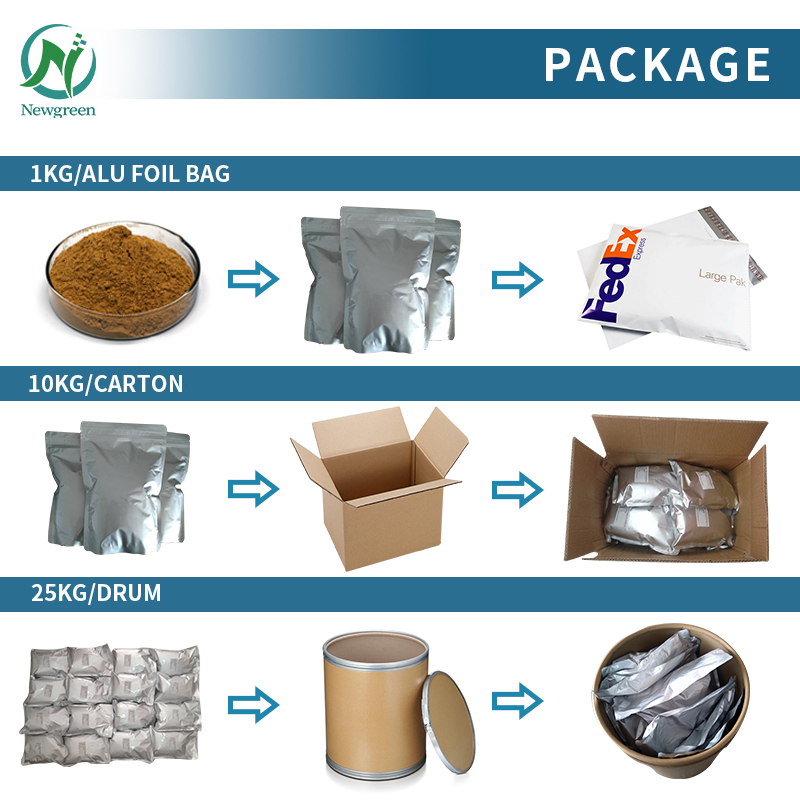
Package & Delivery